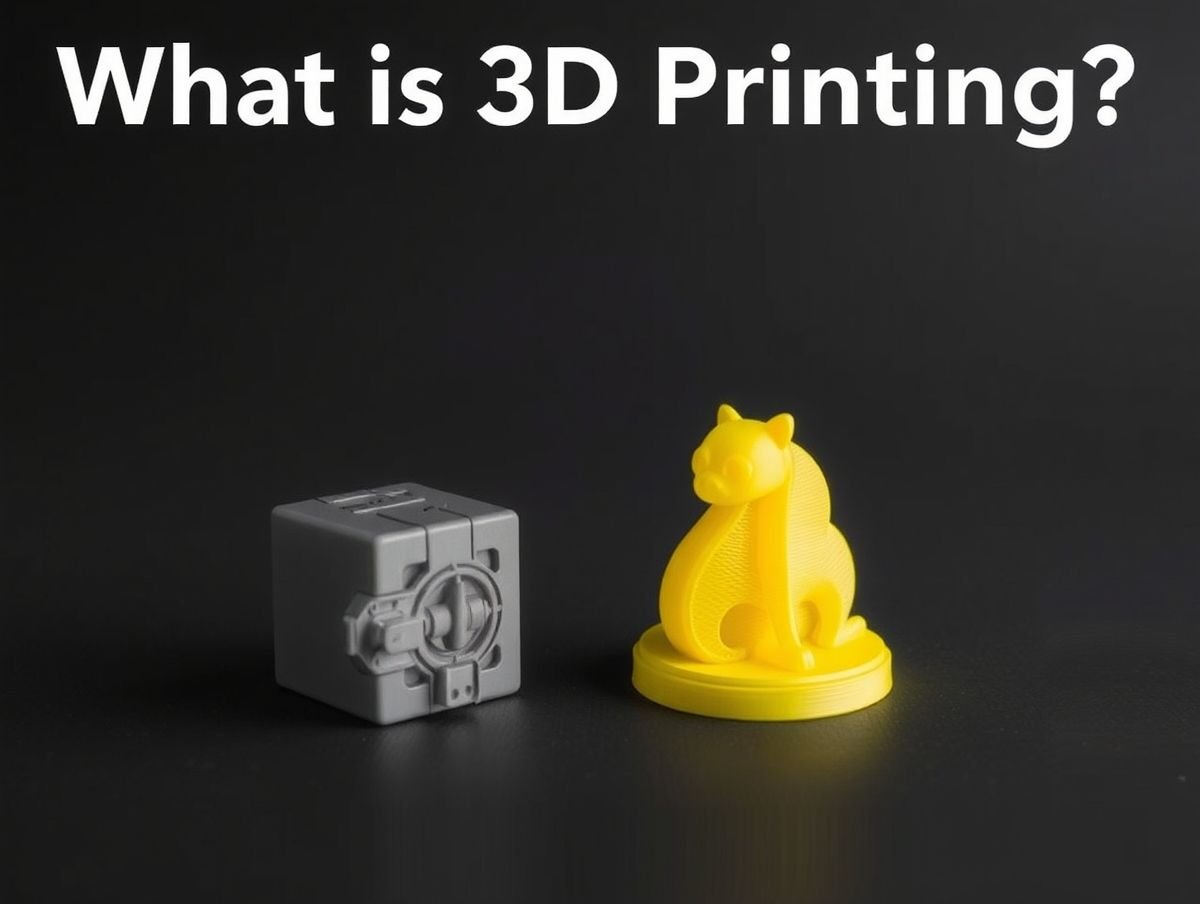
What is 3D Printing? Your Essential Guide to the Future of Making Things
Estimated reading time: 9 minutes
Key Takeaways
- 3D printing builds objects layer-by-layer using digital designs, reducing material waste by up to 90% compared to traditional methods
- Major technologies include FDM (plastics), SLA (high-detail), and SLS (complex geometries)
- Key applications span aerospace, medical, automotive, and education industries
- Best for rapid prototyping, customization, and complex geometries but has material and speed limitations
- Entry-level printers start under $200 with free CAD tools available for beginners
Índice
- What Exactly is 3D Printing?
- How Does 3D Printing Work?
- Types of 3D Printing Technologies
- 3D Printing Advantages and Disadvantages
- Building Your 3D Printing Future
- FAQ
What Exactly is 3D Printing? Your New Manufacturing Superpower
You might think manufacturing needs big machines. Or warehouses full of parts. Not anymore. What is 3D printing? Simply put: It builds objects from digital designs. Layer by tiny layer. Like frosting a cake precisely. This is additive manufacturing. It adds material. Traditional methods subtract. They cut away material. That wastes up to 90% of raw blocks!
CNC Machining vs 3D Printing Comparison
Additive vs. Subtractive: Why You Win
Subtractive machining carves objects from solid blocks. Think CNC routers. They’re loud. Messy too. You lose valuable material as shavings. Additive printing uses only what’s needed. Less waste saves you money. It’s eco-friendly. Seriously though—imagine printing spare parts on demand. No more waiting.
The 4-Step Workflow Simplified for You
- Conceção: You create a 3D model using CAD software.
- Slice: Software chops your model into printable layers.
- Print: Your machine builds each layer.
- Finish: You clean and polish the object.
Where You’ll See 3D Printing Changing Lives
- Aerospace: Lightweight satellite parts slash fuel costs. Airbus prints cabin brackets 55% lighter. Source: RapidDirect
- Medical: Dentists print crowns in hours. Surgeons practice on patient-specific heart models. Source: TRUMPF
- Auto Racing: Bugatti printed titanium brake calipers. Stronger than steel! Source: RapidDirect
- Classrooms: Biology students hold printed DNA models. Learning sticks better.
Pro tip: Start with free CAD tools like TinkerCAD. You’ll prototype ideas fast.
How Does 3D Printing Work? Your Step-by-Step Blueprint
You’ve got a brilliant idea. How do you turn it into reality? Let’s break down how does 3D printing work in four clear steps. It’s like baking with precise instructions. Only cooler.
Step 1: Design – Sketching Your Vision
You create a 3D model using CAD software. Beginners love TinkerCAD. Pros use Fusion 360. No design skills? Scan real objects with your phone. Apps like Qlone capture dimensions. Export files as STL or OBJ. These are your printer’s recipes.
Step 2: Preparation – Slicing Your Masterpiece
Special software (like Ultimaker Cura) slices your model. Think deli meat slicer. But digital. It generates G-code instructions. This tells your printer: “Move here. Squirt plastic.” You’ll adjust settings too. Layer height. Support structures. Temperature.
Step 3: Printing – Layer-by-Layer Magic
Your printer reads the G-code. It deposits material precisely. FDM printers melt plastic filament. SLA machines cure liquid resin with lasers. SLS fuses powder with heat. Building layer by layer. A 2-inch toy might take 200 layers! Patience pays off.
Step 4: Post-Processing – The Final Polish
Fresh prints need cleaning. You remove support structures. Sand rough edges. Resin parts require UV curing. Metal prints get heat-treated. Suddenly, your prototype looks pro. Reminds me of a startup that printed drone parts. Post-processing made them shine.
Look: Entry-level printers (like Creality Ender 3) start under $200. You can start today.
Exploring the Types of 3D Printing Technologies: Match Your Needs
Confused by terms like FDM or SLS? You’re not alone. Let’s decode the types of 3D printing technologies. Each excels at different jobs. We’ll compare speed, materials, and costs.
FDM (Fused Deposition Modeling): Your Garage Workhorse
FDM melts plastic filament through a nozzle. Layer by layer. It’s affordable. Mess-friendly too. You use PLA or ABS plastics. Perfect for DIY projects. Or construction prototypes. Companies print concrete wall panels! Source: AMFG
Guide to Prototype Materials
- Best for: Beginners, functional prototypes
- Limits: Visible layer lines, weaker strength
SLA (Stereolithography): Detail Wizardry
SLA uses lasers to harden liquid resin. It creates smooth surfaces. Incredibly precise. Dentists print crowns with 25-micron accuracy. You get medical-grade details. But resin is messy. UV curing is essential.
- Best for: Jewelry, dental molds, miniatures
- Limits: Brittle materials, post-processing labor
SLS (Selective Laser Sintering): No Supports Needed
SLS lasers fuse nylon or metal powder. No support structures required. Complex geometries? Easy. Aerospace firms print air ducts. Lightweight and strong. Source: AMFG
- Best for: Functional parts, aerospace
- Limits: Expensive machines, rough surface finish
Other Game-Changers: PolyJet and Metal
- PolyJet: Prints rubber and rigid plastic together. Ideal for robotics grips.
- Metal 3D Printing: Laser melts metal powder. Stronger than casting. Race cars use printed titanium parts. Source: RapidDirect
Technology Comparison: Picking Your Solution
| Technology | Speed | Materiais | Accuracy | Cost |
|---|---|---|---|---|
| FDM | ★★☆ | Plásticos | 0.1-0.3mm | $ |
| SLA | ★☆☆ | Resins | 0.025mm | $$ |
| SLS | ★★★ | Nylon, Metal | 0.1mm | $$$ |
Seriously though: Match technology to your project. Don’t overpay.
Weighing the 3D Printing Advantages and Disadvantages: Smart Choices
Is 3D printing always the answer? Nope. Let’s explore 3D printing advantages and disadvantages. You’ll make informed decisions. Save money too.
Why You’ll Love 3D Printing: The Pros
- Prototipagem rápida: Test designs in hours, not weeks. Rapid Prototyping Deep Dive GM slashed prototyping costs by 70%.
- Personalização: Print implants matching patient bones. Source: TRUMPF
- Geometrias complexas: Create hollow structures. Like lightweight aerospace lattices.
- Cost Efficiency: No molds needed. Print on-demand. Cut inventory costs.
The Harsh Realities: Cons You Can’t Ignore
- Speed Issues: Printing one item takes hours. Mass production? Injection molding wins. Manufacturing Comparison
- Material Limits: Plastics lack metal strength. Functional Part Limitations Surface finishes often need smoothing.
- Post-Processing Hassles: Resin prints require washing. Supports must be snipped.
- High Entry Costs: Industrial SLS printers exceed $100,000. Metal powders cost $500/kg.
Your Decision Checklist: When to Use 3D Printing
- ✅ Yes for: Custom medical devices, prototype iterations, low-volume bespoke parts
- ❌ No for: High-volume runs (>1,000 units), load-bearing metal components, smooth finish-critical items
Pro tip: Use 3D printing for jigs and fixtures. You’ll speed up assembly lines.
Let’s Build Your 3D Printing Future: Next Steps Made Easy
So, what is 3D printing? It’s additive manufacturing. Layer-by-layer creation. You’ve seen its power. From aerospace to your garage. We covered how it works. Key technologies. And honest pros/cons.
Your Action Plan:
- Start Simple: Try free STL files on Thingiverse.
- Choose Wisely: Pick FDM for affordability. SLA for details.
- Design Smart: Use TinkerCAD for quick models. Prototype Scaling Strategies
- Connect: Join maker communities like Reddit’s r/3Dprinting.
The future? Bioprinting human tissue. Sustainable materials. Imagine printing houses with local soil! You could pioneer this.
Frequently Asked Questions
Can I print metal at home?
Not yet—industrial machines only.
Is 3D printing expensive?
Entry-level starts at $200.
What’s the strongest material?
Carbon-fiber infused nylon.
Ready to start your project? Get expert guidance:
Contact QDJ-Prototype for Your Custom 3D Printing Solution

