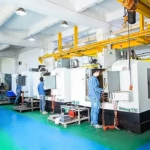
In the world of product development, turning ideas into tangible realities is a crucial step towards innovation and success. Rapid prototyping plays a essential role in this process, allowing businesses to quickly bring their ideas to life and iterate on designs before moving into full-scale production. However, as with any valuable service, rapid prototyping pricing is an important consideration that businesses must understand to make informed decisions. We examine into the details of rapid prototyping pricing, unraveling its components and shedding light on how it can impact your product development journey.
The Value of Rapid Prototyping

Before we dive into the realm of rapid prototyping pricing, it’s important to recognize the immense value that this process brings to product development. Rapid prototyping enables businesses to transform abstract ideas into tangible prototypes with remarkable speed and precision. It allows for quick iteration, validation, and refinement, ultimately leading to enhanced product quality and customer satisfaction.
The benefits of rapid prototyping extend beyond the ability to visualize and test designs. It significantly reduces time-to-market, mitigates risks associated with costly tooling and manufacturing, and fosters an environment of innovation and creativity. By embracing rapid prototyping, businesses gain a competitive edge by being able to respond swiftly to market demands and evolving customer needs.
Factors Influencing Rapid Prototyping Pricing
Understanding the factors that contribute to rapid prototyping pricing is essential for businesses to effectively manage their budgets and make informed decisions. Let’s explore the key elements that can influence the pricing of rapid prototyping:
1. Design Complexity
The complexity of the design is a significant factor in determining the rapid prototyping pricing. Intricate and intricate designs often require advanced techniques, specialized materials, and expert knowledge, which can contribute to higher costs. Complex geometries, intricate surface details, and intricate internal structures may require additional time, resources, and expertise to execute accurately.
2. Material Selection
The choice of materials used in rapid prototyping can have a substantial impact on the overall pricing. Different materials come with varying costs, and their properties can influence the feasibility and quality of the prototypes. From basic thermoplastics to high-performance polymers and metal alloys, each material option carries its own cost considerations.
3. Printing Technology
Rapid prototyping encompasses a range of printing technologies, and the selection of the appropriate technology can affect the pricing. Technologies such as stereolithography (SLA), selective laser sintering (SLS), and fused deposition modeling (FDM) have different equipment, material, and operational costs. The complexity of the design, desired accuracy, and functional requirements will determine the most suitable printing technology and its associated pricing.
4. Quantity and Scale
The quantity and scale of prototypes required can impact the pricing of rapid prototyping. Producing a single prototype or a small batch of prototypes typically incurs higher costs per unit compared to larger production runs. However, economies of scale come into play, meaning that as the quantity increases, the pricing per unit may decrease. Businesses need to evaluate their specific needs and strike a balance between pricing and quantity to optimize their investment.
5. Finishing and Post-Processing
Finishing and post-processing requirements can significantly influence the pricing of rapid prototyping. Depending on the desired aesthetics and functionality of the prototypes, additional steps such as surface smoothing, painting, polishing, or assembly may be necessary. Each finishing process adds to the overall pricing and should be considered when evaluating the total cost.
Strategies for Managing Rapid Prototyping Pricing

While rapid prototyping pricing can vary based on several factors, there are strategies that businesses can employ to manage and optimize their costs. Here are some valuable approaches to consider:
1. Design Optimization
Investing time in design optimization can yield significant cost savings in rapid prototyping. By simplifying complex geometries, reducing unnecessary features, and ensuring designs are suitable for the chosen printing technology, businesses can minimize material waste and printing time, resulting in reduced costs.
2. Material Selection Analysis
Conducting a thorough analysis of material options is essential to strike the right balance between performance and cost. Evaluating the functional requirements, durability, and desired aesthetics of the prototype can help in selecting the most suitable and cost-effective material.
3. Batch Production
If the need for prototypes extends beyond a single unit, considering batch production can be a cost-effective approach. By producing multiple prototypes in a single print run, businesses can benefit from economies of scale and potentially reduce the cost per unit.
4. Collaboration with Experts
Engaging with experienced rapid prototyping service providers can bring valuable insights and expertise to the table. These professionals can guide businesses in making informed decisions, optimize designs, and recommend cost-effective solutions tailored to specific project requirements.
5. Iterative Approach
Taking an iterative approach to rapid prototyping allows for continuous improvement and cost optimization. By incorporating feedback and making necessary design iterations in subsequent prototypes, businesses can refine their products while managing costs effectively.
Real Rapid Prototyping Price Examples (Factory Data)
To ground the discussion, here is a real price point from our published case study: 6 machined PEEK parts for a medical device prototype were quoted at USD 195 per part with a 7-day lead time, where other shops quoted 50+ unit minimums at USD 800+ per part. That gap shows why rapid prototyping pricing cannot be reduced to a single number — it is a function of material, quantity, tolerance, and finishing.
| Cost driver | Typical impact on price | How to reduce it |
|---|---|---|
| Material | Engineering polymers and metals cost more than commodity plastics | Confirm the exact grade; ask if a substitute meets your requirement |
| Quantity | Per-part price drops as quantity rises (economies of scale) | Batch related parts in one RFQ; QDJ accepts MOQ 1 with no tooling fee |
| Tolerance | Tighter tolerances add machining and inspection time | Specify only the tolerances you actually need |
| Finishing | Anodizing, polishing, and assembly add cost | Separate cosmetic vs functional requirements |
| Tooling | Molds for casting or injection molding are the largest upfront cost | Use CNC machining or 3D printing for low volumes; no tooling fee at QDJ |
Rapid Prototyping Pricing by Process: Comparison Table
| Process | Typical accuracy | Typical lead time | Per-part cost | Best for |
|---|---|---|---|---|
| 3D printing (FDM/SLS) | ±0.300 to ±0.500 mm | 1-3 days | Low | Early design iterations, fit checks |
| CNC machining | ±0.001 to ±0.125 mm | 3-10 working days | Medium | Functional prototypes, production-like parts |
| Vacuum casting | High detail | Days | Medium | 10-50 copies with cosmetic finish |
| Injection molding | Production-grade | Weeks (tooling) | Low per part, high tooling | 100+ units, mass-production simulation |
Accuracy and lead-time figures above follow the same published comparison used across our CNC vs 3D printing guide; tolerance range reflects our factory capability of ±0.001 mm to ±0.2 mm.
How to Get an Accurate Rapid Prototyping Quote in 5 Steps
- Prepare your CAD and spec: include material grade, quantity, tolerance, and surface finish requirements.
- Request a free DFM review: a real factory returns design feedback (wall thickness, draft, tolerances) before quoting — not just a number.
- Compare itemized quotes: material, machining, finishing, and tooling should be separate line items.
- Confirm lead time and shipping: agree on the production schedule and incoterm before approving.
- Start with one test part: QDJ accepts MOQ 1 with no tooling fee, so you can validate quality and communication before scaling.
Frequently Asked Questions
Conclusion
Understanding rapid prototyping pricing is essential for businesses embarking on the journey of product development. By considering factors such as design complexity, material selection, printing technology, quantity requirements, and post-processing needs, businesses can make informed decisions to strike a balance between cost and functionality.
While the pricing of rapid prototyping may vary, leveraging strategies such as design optimization, material analysis, batch production, collaboration with experts, and iterative approaches can help businesses manage costs effectively and unlock the full potential of rapid prototyping.
Ultimately, the benefits of rapid prototyping outweigh the costs, as it accelerates innovation, reduces time-to-market, and fosters a culture of creativity and competitiveness. By embracing the power of rapid prototyping and understanding its pricing dynamics, businesses can bring their ideas to reality with confidence and drive their path to success.
Key Numbers at a Glance
These are the concrete figures behind the pricing discussion above. They are stated explicitly so that any quote you receive can be checked against them.
- 50+ CNC machines running 24/7 at our manufacturing partner’s facility in Dongguan, China.
- Free DFM design review within 12 hours — completed before quoting, so manufacturability, tolerance and cost risks are identified before you commit.
- MOQ 1 — quantities from 1 to 10,000 parts. The same process covers prototypes and bridge production.
- Direct manufacturer, not a trading company. Quoting, engineering review and production are handled by one organisation.
- ISO 9001:2015 quality system at our manufacturing partner (certificate holder disclosed on request), with a CMM inspection report per shipment.
- 12+ years serving overseas hardware R&D teams from prototype through low-volume production.
- Two native site languages (English and German).
FAQ: Frequently Asked Questions
Why do two suppliers quote the same part so differently?
Usually because they are quoting different things: different alloy, different tolerance band, different inspection scope, or different material stock position. Making those three explicit is what makes quotes comparable.
Is the DFM review really free, and does it commit me to ordering?
Yes and no respectively. The review is returned within 12 hours at no charge, and it does not commit you to ordering — its purpose is to surface cost and manufacturability risk before you decide.
What drives prototype unit price the most?
Iteration count, then tolerance band, then material. Machining a revised design means a new programme and new material, so settling the functional requirements early is the largest single saving.
Do prices fall at higher quantities?
Unit price falls as setup and programming are spread across more parts. Quantities from 1 to 10,000 parts are quoted, and batching a larger run once is usually worth more than negotiating the rate.
Questions Buyers Ask About Prototyping Cost
These are the questions buyers actually ask at quoting stage. Each has a concrete answer, because each one changes cost, lead time or inspection scope.
What Makes Two Quotes for the Same Part Differ So Much?
Different alloy, different tolerance band, or different inspection scope. Until those three are fixed, the comparison is between different parts, not different prices.
How Is the Cost of a CNC Machining Company Calculated?
Cycle time, programming and setup, tooling, material and inspection. An itemised quotation shows each line so the total can be challenged.
Which Design Decision Saves the Most Money?
Tolerance placement. Applying tight tolerances only to the features that function is usually the largest single saving on a machined part.
Does Batch Size Lower the Cost per Part?
Yes — setup and programming are spread across more parts. Quantities from 1 to 10,000 parts are quoted, so batching can be decided on real numbers.
Is the DFM Review Free, and Does It Commit Me to Ordering?
It is free and returned within 12 hours; it does not commit you to anything. Its purpose is to surface cost and manufacturability risk before you decide.
What Extra Costs Appear After the Quote?
Usually only the ones added afterwards: inspection requested late, unstated surface finish, or a changed drawing. Naming them up front is what keeps a quote final.
How Do You Compare Alternative Suppliers in China?
Give each supplier the identical alloy, tolerance band and inspection scope, and ask who the certificate holder is. Same brief in, comparable quotes out.